What a full-view door is
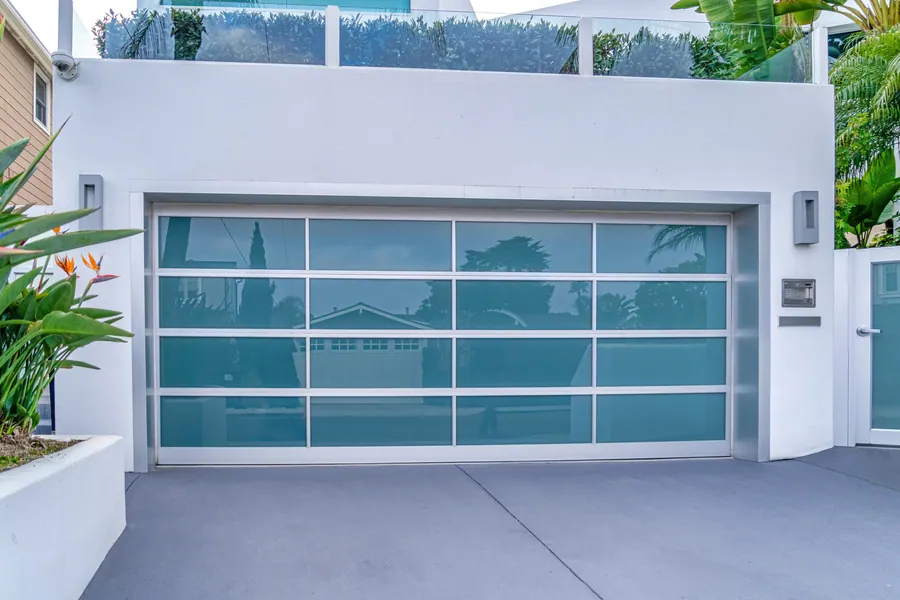
The door goes by several names: all-glass, full-view, and aluminum and glass. In each case, the construction is the same. Each section is a frame of extruded aluminum, with horizontal rails and vertical stiles, and the spaces between are filled with glass in place of steel or timber. The proportion of glass to frame is high, commonly four-fifths or more of the surface.
The type was developed for commercial use. It is the door of the service station, the fire station, and the car showroom, and it was adopted for houses when modern domestic architecture began to seek the same openness. It operates as any sectional door does, on tracks, with a spring counterbalance and, usually, an electric operator.
Where it is used
On modern houses
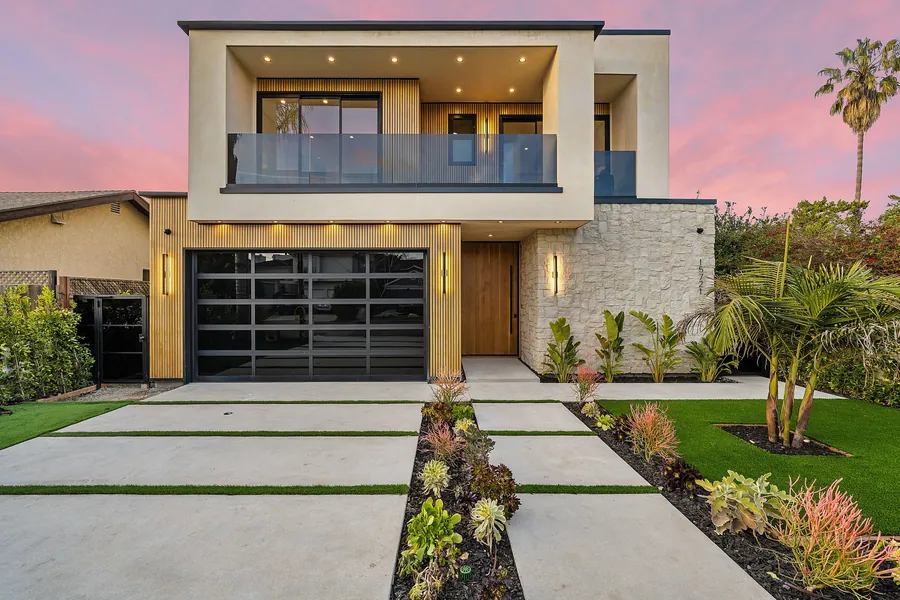
A full-view door suits a house of contemporary design, where the garage front is treated as part of a composition in glass, metal, and masonry. Lit from within at dusk, it has a presence no opaque door can match.
On spaces that are more than garages
Many of the glass doors we are asked about are not for parking at all. They enclose a workshop, a studio, a home gymnasium, or a room for entertaining that opens to a terrace. On lake properties around Hartland, they are fitted to lower-level rooms facing the water, where the door is raised in summer to join indoors and out. In such uses, a retractable screen is a natural companion, as described under garage door screens.
On commercial premises
Restaurants and taprooms with opening fronts, showrooms, and service bays where staff must see vehicles approaching. For these, see also commercial garage door installation.
The choices to be made
The glass
All glass in a garage door must be safety glass, which in practice means tempered. Beyond that, there are two decisions.
Single or insulated. Single glazing is one pane, about an eighth of an inch thick. Insulated glazing is two panes with a sealed air space between. In Wisconsin, on any space that is heated or attached to the house, insulated glass is the only sensible choice. Low-emissivity coatings and gas filling improve it further.
Clear or obscured. The degree of privacy is set by the glass.
| Glass | Appearance | Privacy |
|---|---|---|
| Clear | Fully transparent | None |
| Tinted (gray or bronze) | Transparent, darkened | Slight by day, none when lit from inside at night |
| Satin-etched or frosted | Translucent white | High. Shapes only. |
| Obscure or patterned | Textured | High |
| Mirrored | Reflective from outside by day | High by day, none at night when lit within |
| Laminated white | Opaque white | Complete |
For a garage that holds vehicles and stored goods, frosted glass is the usual recommendation. It admits a soft, even light and conceals the contents.
The frame
Aluminum frames are finished by anodizing, in clear, bronze, or black, or by powder coating in almost any color. Black and dark bronze are the most often chosen for houses. The width of the rails and stiles varies between products. Narrower members give a lighter appearance, and wider ones a more industrial look.
Solid aluminum panels can be substituted for glass in any position. A bottom section of solid panels is a practical choice where the lower glass would be exposed to road spray, snow, or impact.
On any space that is heated or attached to the house, insulated glass is the only sensible choice.
The matter of warmth
It would be wrong to suggest that a glass door insulates as a foam-filled steel door does. It does not, and in this climate the difference is felt.
Aluminum is an excellent conductor of heat. A plain aluminum frame carries cold directly from outside to inside, and in a Wisconsin January, frost or condensation will form on its inner face. The better doors address this with a thermal break, a strip of low-conductivity material that separates the inner and outer parts of each frame member. Some also fill the hollow frame with foam.
For a heated or conditioned space, we advise a door with thermally broken frames and insulated, low-emissivity glass. Even so, the opening should be regarded as a large window and the heating of the room provided for accordingly.
For an unheated, detached garage used only for vehicles, a simpler door may be acceptable, on the understanding that it will be cold and prone to condensation.