Garage doors for Hartland and Lake Country, Wisconsin

(000) 000-0000
Hartland Garage Door Service
(000) 000-0000

Commercial and specialty

Sectional and Dock Doors in Hartland, Wisconsin

The loading dock is where a building meets its freight. Its doors open and close all day, in all weather, a few feet from maneuvering trucks and forklifts. They must be chosen and installed with those conditions in view.

(000) 000-0000
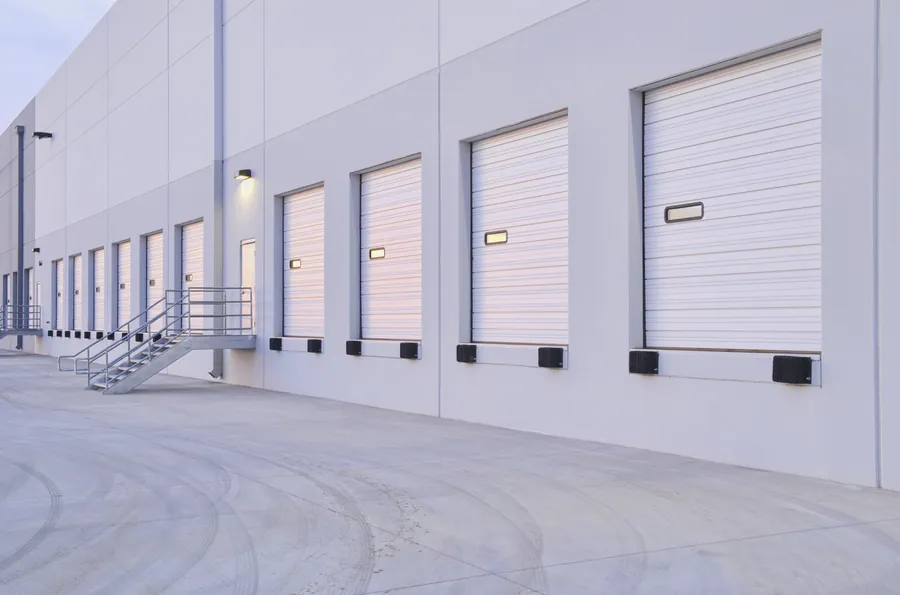
Row of insulated dock doors along a distribution building
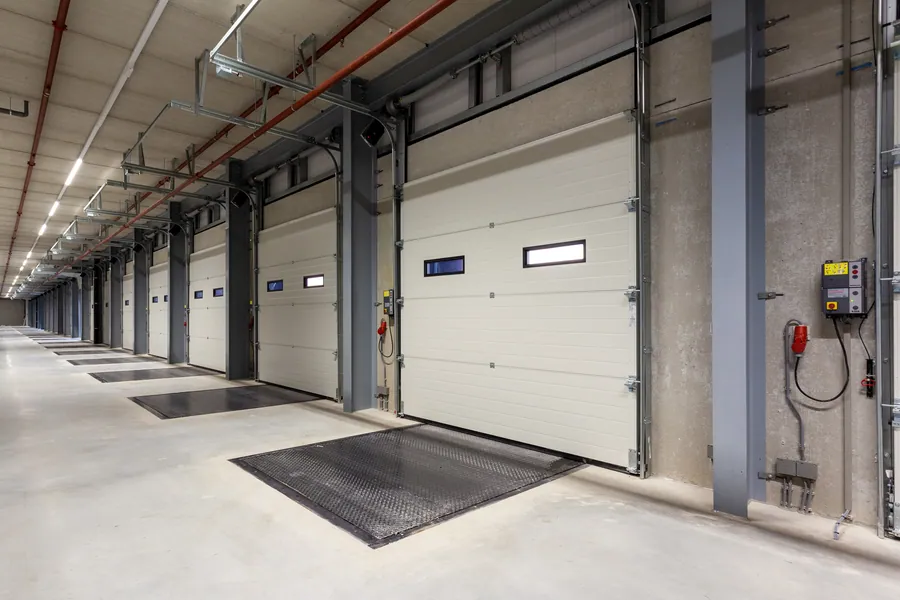
Interior of a loading dock with sectional doors and levelers
Usual dock door
8 or 9 ft wide, 9 or 10 ft high
Track
High-lift or vertical-lift
Priority
Seal and durability

The commercial sectional door

In principle, a commercial sectional door is the same machine as the door on a house: hinged sections, rollers in tracks, and a torsion spring counterbalance. In execution, it is a heavier thing altogether.

The sections are commonly an inch and three-quarters to three inches thick, with polyurethane foam bonded between two steel skins. The track is of two-inch pattern on lighter doors and three-inch on heavier ones, in a thicker gauge of steel. The shaft is solid or of heavy-wall tube, running in sealed bearings. Hinges and rollers are of industrial grade, with long-stem rollers at the positions that carry the most load. Springs are larger in every dimension and are offered in cycle ratings many times the residential standard.

The sectional door has become the standard for docks and drive-in bays for a simple reason. Of all the common commercial door types, it insulates best and seals most tightly.

Dock doors and drive-in doors

The two serve different purposes and are proportioned differently.

Dock doors stand at trailer-bed height, roughly four feet above the yard, and open onto the rear of a truck. They need be only a little wider and taller than a trailer. Eight feet by nine or ten, and nine feet by ten, are the usual sizes. Each is commonly paired with a dock leveler in the floor and a seal or shelter on the outside wall.

Drive-in doors stand at grade and admit vehicles into the building. They are larger: twelve by fourteen feet is common, and sixteen feet high or more where trailers and equipment must pass.

A building generally has many more dock doors than drive-in doors, and the dock doors cycle more often.

Track arrangements

How the track is laid out determines where the door goes when it is open, and on a dock, that matters a good deal.

Arrangement Path of the door Where it is used
Standard lift Rises and turns back horizontally just above the opening Low ceilings. The open door and track occupy the space above the dock.
High lift Rises vertically for some distance above the opening, then turns back Buildings with moderate clear height. Keeps the door clear of forklift masts and racking.
Vertical lift Rises straight up the wall Buildings with ample clear height. Nothing projects into the room.
Follow-the-roof Track pitched to follow a sloping roof line Buildings with pitched roofs and limited height at the eaves

On a dock, we prefer vertical lift or high lift wherever the building permits. Horizontal track above a dock position is exposed to forklift masts and raised loads, and it is the most frequently damaged part of a standard-lift dock door.

High-lift and vertical-lift doors use tapered or stepped cable drums, which alter the leverage as the door rises. The springs must be calculated for the specific drum and lift. An error here produces a door that is heavy at one point of its travel and light at another.

Horizontal track above a dock position is the most frequently damaged part of a dock door.

Features worth specifying on a dock

  • Impact-resistant bottom sections The lowest section takes blows from pallets and forks. Reinforced or sacrificial bottom sections, and breakaway designs that release from the track and reset, greatly reduce repair costs.
  • Vision lites A small insulated window at eye level allows staff to see whether a trailer is in position before the door is opened.
  • Full perimeter seals Jamb, header, and bottom seals, with the bottom astragal sized to close on the leveler lip.
  • High-cycle springs Dock doors are among the busiest in any building.
  • Track guards Steel protectors at the base of the vertical track, where forklifts strike.
  • Locking A slide lock or an interlock that ties the door to the vehicle restraint and leveler.
  • Exhaust ports and pass doors Where the use requires them.

The dock as a system

A dock door does not work alone. It is one of several components at each position, and they must be coordinated.

The leveler bridges the gap between the building floor and the trailer bed. Where it is a pit-mounted type, the door closes onto the floor behind it. Where it is a vertical-storing type, the door closes in front of it, onto the pit floor, which gives a better seal.

The dock seal or shelter closes the gap between the building wall and the trailer. Foam seals compress against the trailer. Shelters use curtains that drape over it.

The vehicle restraint holds the trailer at the dock.

Bumpers absorb the impact of the trailer.

When we install dock doors, we establish what is fitted at each position and make certain the door, its track, and its seals are compatible with it.
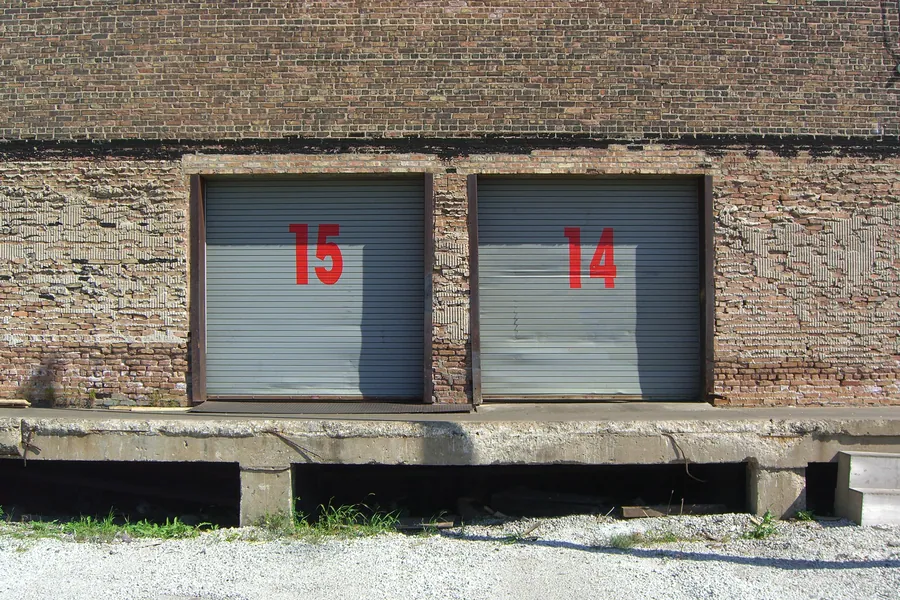
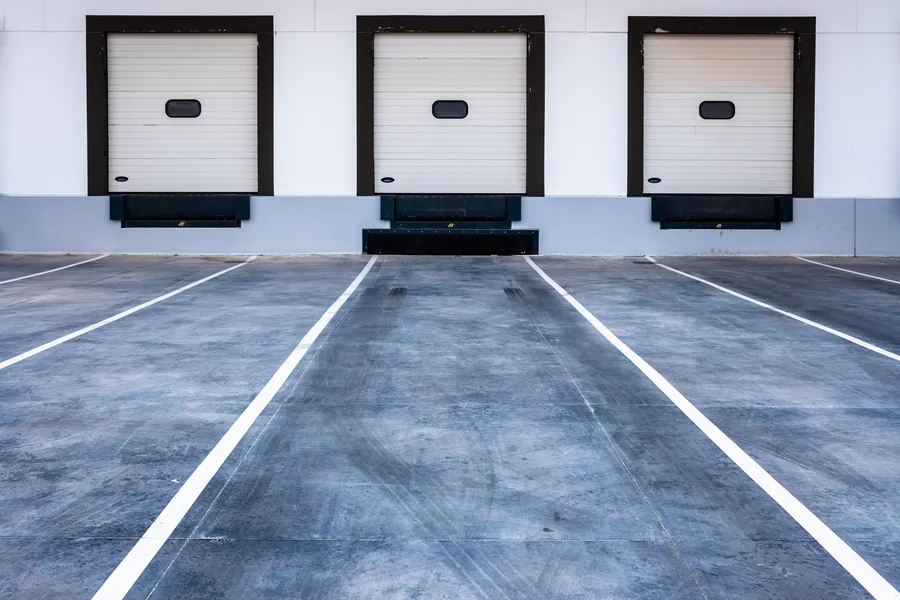
Before and after

Worn dock doors on an old warehouse and a new row of dock positions

The first photograph shows two dock doors, numbered 15 and 14, on an old brick warehouse. The doors are worn and stained, there is no seal or shelter around either, and the dock face below has crumbled. Positions like these leak heat, admit weather, and are slow and awkward to work.

The second photograph shows three new dock positions, each with an insulated sectional door, a shelter to close around the trailer, and marked lanes on the apron. Bringing an old dock to this standard involves new doors on high-lift or vertical-lift track, coordinated with levelers and seals. The building then holds its heat, and trucks are turned around more quickly.

BeforeBefore: Aged dock doors numbered 15 and 14 on a brick warehouse
AfterAfter: Three new dock doors with shelters and painted lanes
Illustrative comparison using licensed stock photography. It shows the kind of change this service makes and is not a documented customer project.

Insulation and energy

A row of dock doors is a large area of wall. In a heated warehouse in Wisconsin, its thermal performance has a direct effect on operating cost.

The insulation of the sections is one consideration. Polyurethane-filled sections of two inches or more, with a thermal break at each joint, are appropriate for conditioned buildings. Air leakage is the other, and it is commonly the larger. A door with worn or missing seals leaks continuously, whatever its sections are made of.

How the door is used counts for most of all. A dock door standing open with no trailer present loses more heat in ten minutes than a closed door does in a day. Interlocked controls, vision lites, and well-maintained operators all encourage staff to keep doors shut. Where traffic is constant, a high-speed door inside the sectional door may be warranted.

For cold storage and food handling, thicker sections, heated perimeter seals, and other special provisions are available.

Winter at the dock

Ice at the threshold. Meltwater from trailer roofs runs down onto the leveler and the door sill and freezes. A bottom seal frozen in place will be torn if the door is operated. The area should be kept clear, and seals of a cold-rated compound specified.

Snow. Plowed snow should not be piled against dock doors or shelters.

Salt. Trailers bring it in quantity. Bottom sections, bottom brackets, the lower track, and cable ends are the first parts to corrode. Galvanized or stainless hardware in these positions is worth its cost.

Cold and lubricants. Bearings, rollers, and operator gearboxes should be serviced with low-temperature lubricants before winter.

Wind. Dock walls are often long and exposed. Doors are specified to the wind load for the site.

Drive-in bays

Drive-in doors are larger and heavier, and they are nearly always motorized. A jackshaft operator beside the door, with high-lift or vertical-lift track, keeps the overhead clear for vehicles and cranes. Photoelectric sensors and a sensing edge are fitted. Where the bay is a wash bay or otherwise wet, corrosion-resistant hardware and a suitably rated operator are specified.

Glazed sections admit daylight to a workshop and allow those inside to see vehicles approaching. Full-view aluminum doors may be used where a bay is also a place of display.

Installation and replacement

The course of a project is as described under commercial garage door installation. On an operating dock, doors are replaced a position at a time, so that shipping and receiving continue. Each opening is ordinarily out of use for part of a day.

Where existing doors are sound but damaged, individual sections, track, and hardware can be replaced without renewing the whole door.

Maintenance

A dock door in constant use should be inspected at least twice a year, and more often where traffic is heavy. Spring tension and balance, cables, bearings, rollers, track alignment and fasteners, seals, and the operator and its safety devices are all examined. Planned replacement of springs on a schedule, before they fail, avoids the loss of a dock position at a busy time.

Questions and answers

Questions about sectional and dock doors

What size is a standard dock door?

Eight or nine feet wide and nine or ten feet high are the most common. The size is chosen to suit the trailers served and the seal or shelter used.

What is the difference between high lift and vertical lift?

A high-lift door rises vertically for part of its travel before turning back along the ceiling. A vertical-lift door rises straight up the wall and has no horizontal track.

How often should dock door springs be replaced?

That depends on the cycle rating and the use. On busy doors, we recommend replacement on a planned schedule before failure.

Can a damaged bottom section be replaced on its own?

Usually, yes, provided the door is a current model. Impact-resistant replacements are available for many doors.

Are sectional doors better than rolling doors for a dock?

For insulation and sealing, yes. Rolling doors are preferred where headroom is very limited or a fire rating is required.

Can dock doors be interlocked with levelers and restraints?

Yes. Interlocked controls prevent the door or leveler from being operated out of sequence.

Estimates in Hartland and Lake Country

Tell us about your dock and we will specify the doors.

Describe the door, the building, and what you would like done. We will reply with any questions and arrange a time to measure or inspect.

(000) 000-0000

Your details are used only to respond to this request.

Call