Why choose wood
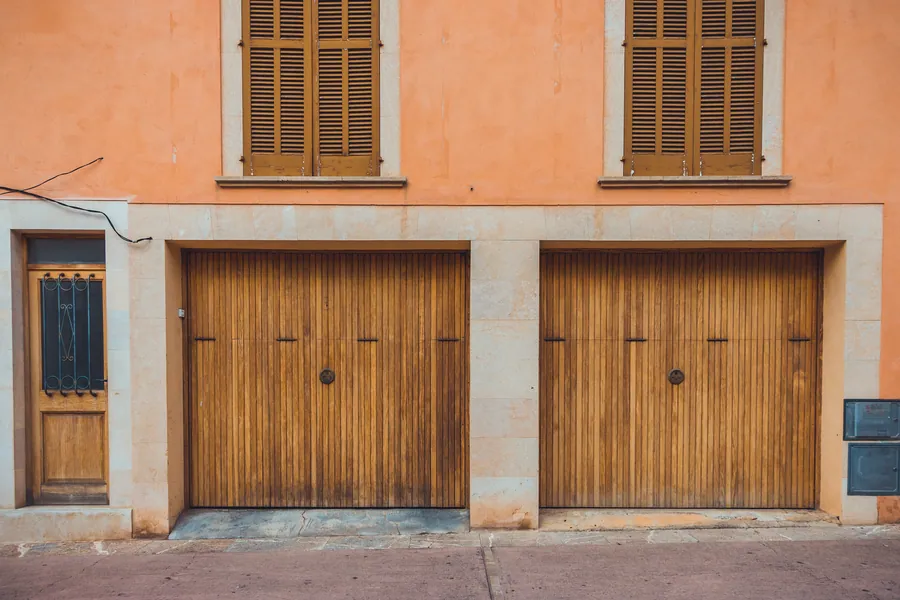
A steel door printed with a wood grain may deceive the eye from the street. It will not do so from the driveway, and it never acquires the character that timber does. Wood has grain that varies from board to board, a surface that takes stain in depth, and edges and joints that can be worked by hand. No two doors are alike.
It is also the only material in which a door may be made to any design. Because each door is built from the drawing, there is no catalogue to confine it. An arched head, an unusual width, boards laid in herringbone, panels proportioned to match the entrance door, or a pattern taken from an old photograph of the house can all be made.
For a house of real architectural quality, or for an owner who values material honesty, there is no substitute.
What it requires in return
We put this plainly, since it is better understood before the order than after.
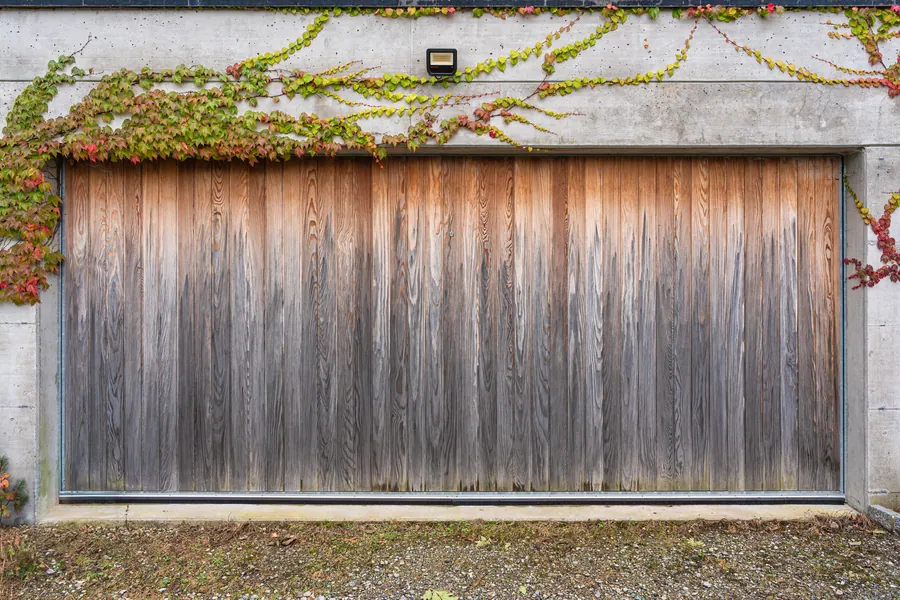
Wood moves. It takes up moisture in a humid summer and gives it up in a dry, heated winter, and it swells and shrinks as it does so. A finish that is allowed to fail lets water into the timber, and the cycle of wetting and drying then opens the joints, raises the grain, and eventually leads to decay.
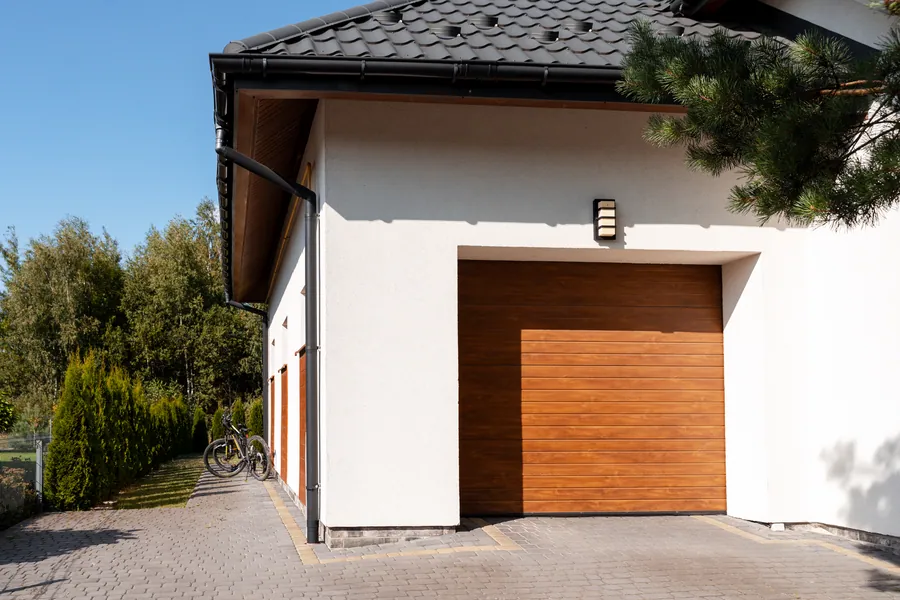
In the climate of southeastern Wisconsin, a wood garage door should be expected to need its finish renewed every two to four years. Doors facing south or west, which receive the most sun, will need attention sooner than those facing north or east. The bottom rail, where snow lies and water splashes, needs the closest watch of all.
An owner who will keep to that regime will have a door that lasts for generations and grows more handsome with age. An owner who will not should consider a composite overlay or a wood-tone steel door, which we describe under carriage house and contemporary doors. There is no discredit in the choice.
A wood door kept in finish will last for generations. One that is neglected will not last two decades.
Species
| Species | Character | Notes |
|---|---|---|
| Western red cedar | Light, stable, naturally resistant to decay. Warm reddish-brown with pronounced grain. | The most widely used. Takes stain well. Relatively soft. |
| Douglas fir | Straight-grained and strong, pale with a pinkish cast | Good for painted doors and for clear finishes of a quieter kind |
| Hemlock | Pale, even, and smooth | Economical. Best painted. |
| Mahogany and sapele | Dense, fine-grained, and richly colored | Very durable and stable. Heavier and more costly. |
| White oak | Hard and heavy, with a bold figure | Durable, but its weight calls for substantial hardware |
| Knotty alder | Rustic, with open knots | Suits lodge and cabin styles. Softer than most. |
For most houses in this area, we suggest western red cedar or one of the mahoganies. Cedar is the lighter and more economical. Mahogany is the more refined and the longer lived.
Methods of construction
Solid frame and panel. The traditional method, with stiles, rails, and floating panels. It is the heaviest construction and gives the greatest depth.
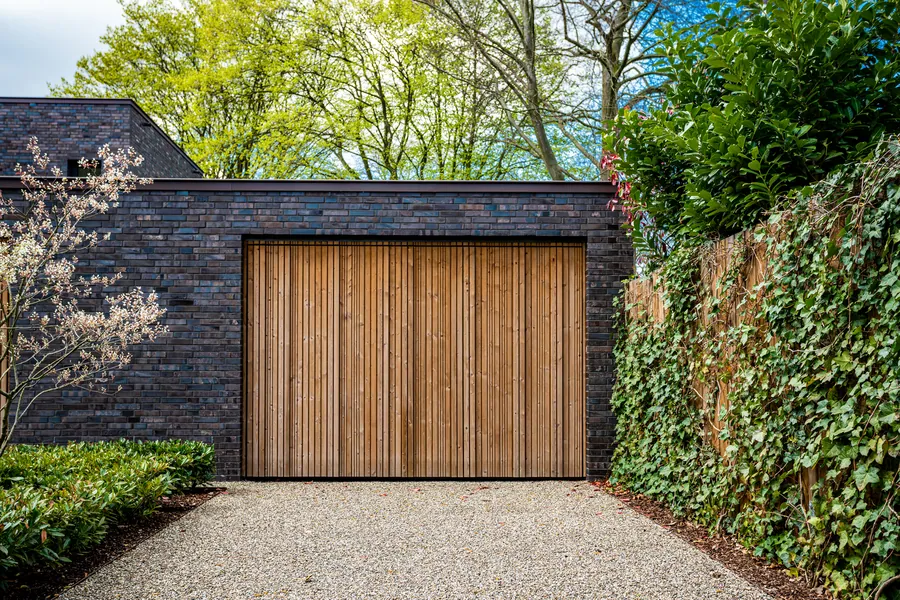
Plank on frame. Boards fixed to a concealed frame, vertically, horizontally, or on the diagonal. Suited to carriage house and contemporary designs alike.
Veneer or overlay on an insulated core. A thick facing of real wood applied to an insulated steel or composite door. It combines the appearance of timber with a stable, insulated core and is considerably lighter. For an attached garage, it is often the wisest construction.
Solid wood has some insulating value of its own, though less than a foam-filled door. Where warmth is a priority, we recommend the insulated core.
Sealing: the detail that decides the life of the door
Every surface of every section must be sealed before the door is hung. That includes the back, the top and bottom edges, and the end grain, none of which will be seen again. End grain absorbs water many times faster than the face, and an unsealed bottom edge is the usual place for decay to begin.
We specify factory finishing wherever it is offered, since a controlled shop produces a more even and durable coat than can be achieved on site. Where a door is to be finished after delivery, it should be done promptly, in suitable weather, and before installation.
Stains with ultraviolet inhibitors, or a good exterior paint, are the appropriate finishes. Clear varnishes that form a film tend to fail by peeling and are difficult to renew.